
the guide for parents who feel it in their gut
iPad Free Kids
“Devil in the Living Room” s a straight-talking, research-informed guide written by a mental health counselor and mom who has seen, up close, what constant screens are doing to kids’ nervous systems and family dynamics.
This isn’t a “just take the iPad away” manifesto.
It’s a calm, grounded explanation of why screens feel regulating in the moment, how they quietly dysregulate the brain over time, and what to do instead without power struggles, shame, or chaos.
This guide helps you understand what’s actually happening inside your child’s brain and body…
so you can reduce screen reliance without war, and replace it with real regulation, connection, and capacity.
You didn’t hand over the iPad because you’re lazy.
You handed it over because:
• you needed to cook
• you needed quiet
• you were nursing the baby
• you were exhausted
• it worked
And then slowly…
It stopped working.
Now you’re living with:
• glazed eyes
• explosive meltdowns when it ends
• constant negotiating
• “just five more minutes”
• a tone shift that feels… off
• boredom intolerance
• zero frustration tolerance
• a house that only feels peaceful when the screen is on
No one is saying this out loud but I will:
The device isn’t the problem.
The dopamine loop is.
And most parenting advice completely misses that. You're opening the door to addiction which is exactly where he wants your kids.
Instant digital download • Most parents read this guide in 45–60 minutes, but many revisit sections as they begin making changes at home.
It’s designed to be digestible, skimmable, and actionable.
No clinical overload. No parenting fluff.
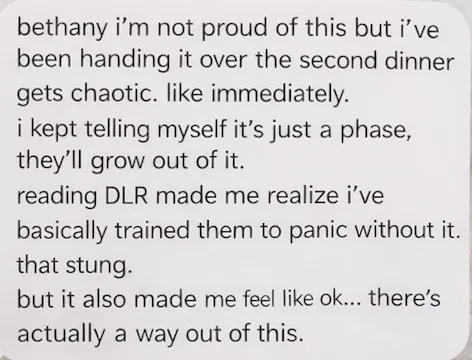
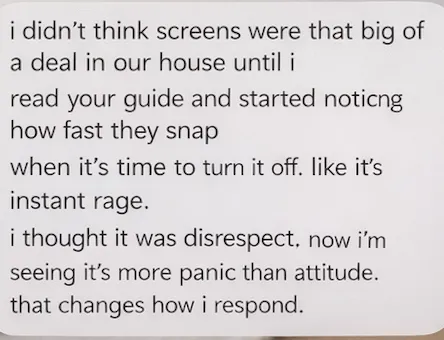
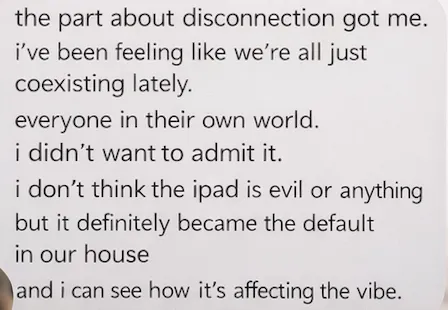

“I thought the iPad was helping my son calm down.
This guide helped me see why his meltdowns were actually getting worse.
We didn’t just remove screens. We finally understood what to replace them with.”
– Megan, mom of 3
If evenings feel like a battle, this guide is for you.
You love your kids. But the meltdowns, backtalk, and screens-everywhere chaos can make your home feel like it's ruled by a tiny dictator. The usual advice—"be consistent," "stay calm," "just ignore it"—isn't cutting it.
Before this guide, many parents feel
Repeating yourself 20 times just to get shoes on.
Screens are the only thing that keeps the peace
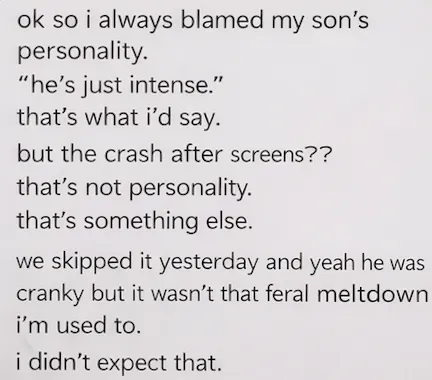
My child melts down the second the iPad goes away
Arguing about homework, bedtime, and screens every single day.
Feeling guilty after you yell—but not sure what else to do.
I’m scared to take screens away because I don’t have a backup plan
Afraid to remove it because you don’t have a replacement plan
Guilty but stuck
Confused about whether this is personality, ADHD, sensory, or screens
This isn’t how you want your house to feel.
After reading this guide, parents gain
✔ Clarity instead of confusion
✔ Language for what’s actually happening in the brain
✔ A nervous-system-first approach to screen reduction
✔ Tools that don’t rely on punishment or bribery
✔ Confidence to lead their home without guilt
✔ What is actually happening in your child’s brain
✔ Why “calm on a screen” is not the same as regulation
✔ Why meltdowns spike when you remove it
✔ How to reduce dependence without punishment
✔ What to replace screens with so the nervous system stabilizes
Not with bribes, behavior charts or fear but with biology.
This guide gives you a calm, doable plan.
This guide doesn’t tell you to parent harder.
It helps you parent smarter, with biology and nervous system regulation in mind.
It reframes screens not as the enemy, but as a signal & then it shows you how to respond.
Screens are not just overstimulating kids.
They are training the nervous system to outsource regulation.
And when you remove the device without rebuilding regulation internally, chaos happens.
That’s why most parents quit.
This guide shows you how to:
• Reduce screen reliance gradually
• Stabilize the nervous system first
• Build boredom tolerance
• Increase frustration capacity
• Shift dopamine patterns back toward real life
This is not anti-technology.
This is pro-regulation.
Inside the eguide
Turn daily power struggles into deeper connection.
“Devil in the Living Room” is a 45-minute guide you can actually finish—and actually use. It's broken into short, real-world chapters you can read between soccer practice and bedtime.
Why screens mimic the dopamine loop of addiction in developing brains.
How “calm” screen behavior differs from true regulation
What boredom, dysregulation, and resistance are actually communicating
How to transition away from iPads without explosive backlash
What's inside each section:
Part 1 —The Dopamine Loop
What screens are doing to attention, mood, emotional regulation, and family dynamics and why “it works” short-term but costs long-term. How screen exposure mirrors addiction pathways in developing brains.
Part 2 — The Brain, the Gut, and the Nervous System
A parent-friendly explanation of dopamine, stress response, gut-brain communication, and why so many kids look anxious, impulsive, or disconnected.
Part 3 — The Shift
How to reduce screen dependence in a way that builds resilience, emotional capacity, and connection instead of conflict.
Who it's for
Built for real families, not perfect ones.
This guide is for parents who feel the tension around screens but don’t want extreme rules, shame-based parenting, or another behavior chart that doesn’t address the root.
You'll get the most out of this if:
You have kids between ages 4–16.
Have kids who melt down when screens end
Suspect screens are masking deeper dysregulation
Want science, not trends
Are ready to lead your home with confidence instead of fear
This is not another guilt trip.
You will not find:
• Shaming
• “Back in my day” parenting
• Fear-based tactics
• Unrealistic expectations
You will find compassion, clarity, and a path forward that respects both your child’s nervous system and your own.
Pricing
One small price for a calmer home.
Skip one takeout dinner and get a guide you’ll revisit every time things feel out of control.
Secure checkout

Meet the author
Hi, I’m the parent coach behind Devil in the Living Room.
I’m a mom of four and a former mental health and addiction counselor with a master’s degree in co-occurring disorders.
I stopped ignoring what I was seeing in families and in my own home.
What I noticed in kids around screens mirrored patterns I had seen for years in addiction and nervous system dysregulation.
I wrote this guide because once you see it, you can’t unsee it and parents deserve honest information, not judgment.
For the last 4 years, I’ve helped over 4000 of families move from crisis-mode parenting to calmer, more connected homes—without magic personalities, unlimited time, or perfect partners.
“Devil in the Living Room” is the resource I kept wishing I could hand busy parents after our sessions: clear, compassionate, and brutally practical. It distills trauma-informed, nervous-system-aware parenting into tools you can start tonight.
Everything I share is tried and true, and gives you solutions to DEEPER HEALING, CONNECTION, AWARENESS, REGULATION and sustainability around ipads that last. We are over 18 months ipad game free!!
Stories from real families
“Our house is still loud—but it’s not a war zone anymore.”
We stopped thinking our son was ‘defiant’ and realized he was overwhelmed.
— James & Lena, parents of 2
“We’d tried every chart and consequence. This was the first thing that actually changed how I showed up—and when I changed, our kids did too.”
— Priya, mom of 3
“We printed the family agreements page and put it on the fridge. It sounds small, but it changed the tone of our evenings. Fewer fights. More laughing.”
— Monica, single parent
Ready to calm the chaos?
Complete your purchase below and get instant access to “Devil in the Living Room.”
Questions, answered
FAQs about “Devil in the Living Room”
Is this guide right for my child’s age?
Yes. The principles apply to toddlers through elementary-aged kids, with a focus on developmentally appropriate nervous system support. Ages 2-15
What format is the guide in?
A downloadable digital e-guide you can read on your phone, tablet, or computer.
How long will it take me to go through?
About 45–60 minutes to read, with sections you’ll likely return to as you implement changes.
What if my co-parent isn’t on board?
This guide gives you language and understanding so you can lead calmly, even if everyone isn’t aligned yet.
What is the free Pause Play Course?
Pause Play is an interactive companion course that helps you apply what you’re learning.
It walks you through:
• Gut-brain communication
• Stress response and regulation
• Why behavior changes stick when the body feels safe
This isn’t just information. It’s integration.
Tonight can feel different.
Grab “Devil in the Living Room,” pick one script, and try it at your next flashpoint. You don’t have to wait for the perfect moment to start changing the story.
Instant digital download • Read on any device